
Course disclosure
- This educational program has been developed by CSL Vifor
- It is intended to provide pertinent data to assist healthcare professionals in forming their own conclusions and making decisions
- It is not intended to replace the judgment or experience of the attending provider or other medical professionals
- Case studies are fictional and intended for educational purposes only
- All prescribing decisions are the sole responsibility of the attending provider
Erythropoiesis is the process by which the hematopoietic tissue of the bone marrow produces red blood cells (RBCs, also known as erythrocytes).1
Erythropoiesis is a continuous process of proliferation and differentiation beginning with the hematopoietic stem cell and ending with RBCs.1

HSC, hematopoietic stem cell; BFU-E, burst-forming unit-erythroid; CFU-E, colony-forming unit-erythroid; Pro-EB, proerythroblasts; EB, erythroblasts; Retic, reticulocytes; RBC, red blood cell.
Adapted from Hamza E, et al. 2020.2
The mean lifespan of a normal human RBC is about 120 days, however in CKD patients RBC lifespan is reduced.1,3
Usually in adults, approximately 200 billion of the oldest RBCs (about 1% of the total number) are replaced every day by an equal number of newly formed RBCs. But, in situations where RBCs are abnormally lost from the circulation, the rate of new RBC production can exceed one trillion per day.1
RBCs are involved in transporting carbon dioxide and nitric oxide, but their principal function is to deliver oxygen from the lungs to the other tissues of the body. Therefore, adequate oxygen delivery to the tissues is dependent on adequate circulating RBCs.1
Erythropoiesis is primarily mediated by a hormone called erythropoietin, which is excreted by the kidneys in adults.3,4
Additionally, adequate supplies of key nutrients like folate, vitamin B12 and iron, are among the numerous requirements for active erythropoiesis.1
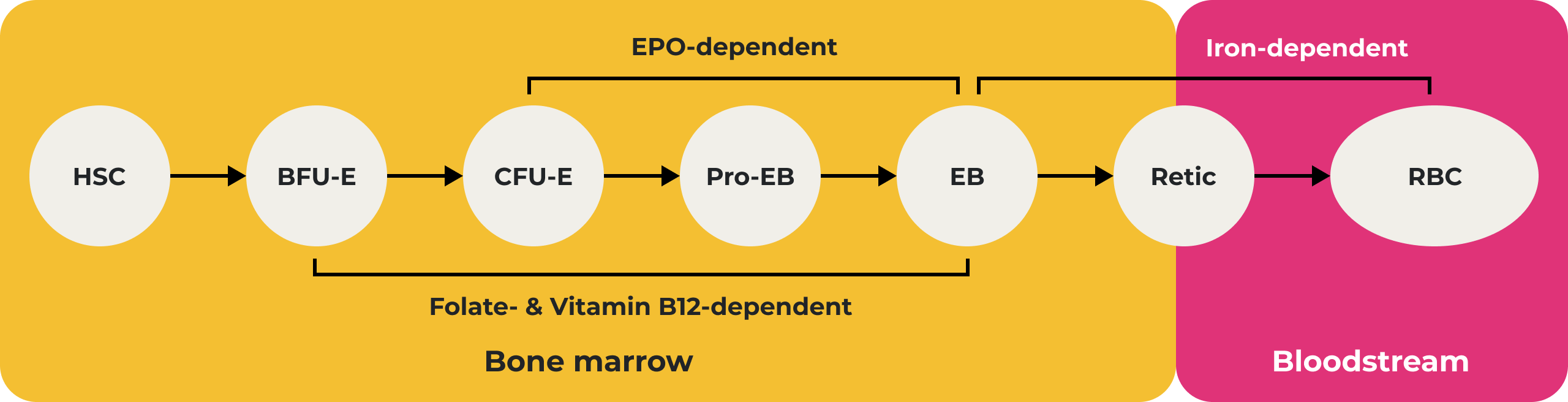
HSC, hematopoietic stem cell; BFU-E, burst-forming unit-erythroid; CFU-E, colony-forming unit-erythroid; Pro-EB, proerythroblasts; EB, erythroblasts; Retic, reticulocytes; RBC, red blood cell.
Adapted from Koury MJ, et al. 2004 and Hamza E, et al. 2020.1,2
EPO is a glycoprotein hormone produced by the peritubular cells of the renal cortex. This hormone stimulates red blood cell production in response to low partial pressure of oxygen (pO2).4
Accordingly, reduced partial pressure of oxygen directly stimulates EPO production, whereas reduced hemoglobin levels stimulate EPO production indirectly.4,5

EPO is essential for the production of RBCs which ensure an adequate oxygen supply to the body.4,5

The kidney produce around 80% of the EPO in adults.3,4
Remaining EPO production occurs in small quantities in the spleen, liver, bone marrow, lung, and brain.4

In chronic kidney disease (CKD) patients, EPO levels are inadequately low, with deficiency starting early in the course of disease.6
However, when eGFR falls below 30 ml/min per 1.73 m2 this deficiency becomes severe.6
The influence of EPO in anemia associated with CKD
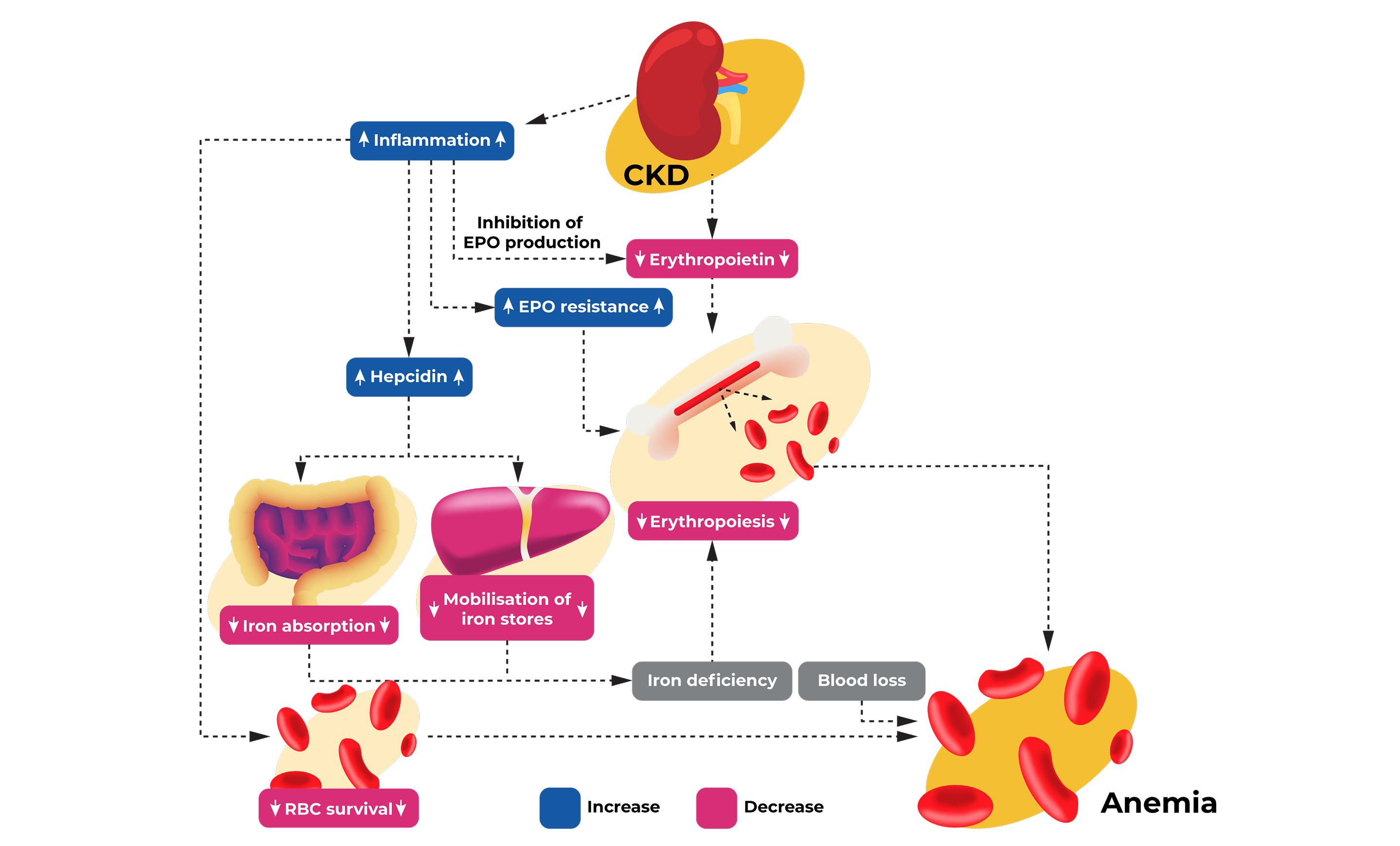
Adapted from Badura K, et al. 2024.7
Monitoring EPO in anemia associated with CKD
Despite its pivotal role in erythropoiesis, EPO is not monitored directly when managing anemia associated with CKD.
Rather, when assessing patients, hemoglobin (Hb) levels and markers of iron status (such as ferritin and transferrin saturation) are used.5
Moreover, when managing therapy with erythropoietin-stimulating agents (ESAs), Hb levels should be monitored regularly.5,8



Folate and vitamin B12 are nutrients found in plant and/or animal-based foods, both of which are essential for effective erythropoiesis.1
In folate or vitamin B12 deficiency, synthesis and repair of DNA is impaired, resulting in cell death. Erythropoiesis under these deficiency conditions is termed ineffective because the erythroid cells are present in the hematopoietic tissue, but most of them cannot mature to the late stages of differentiation before undergoing apoptosis.1
The decreased numbers of erythroid cells surviving until the postmitotic terminal stages in ineffective erythropoiesis leads to anemia.1

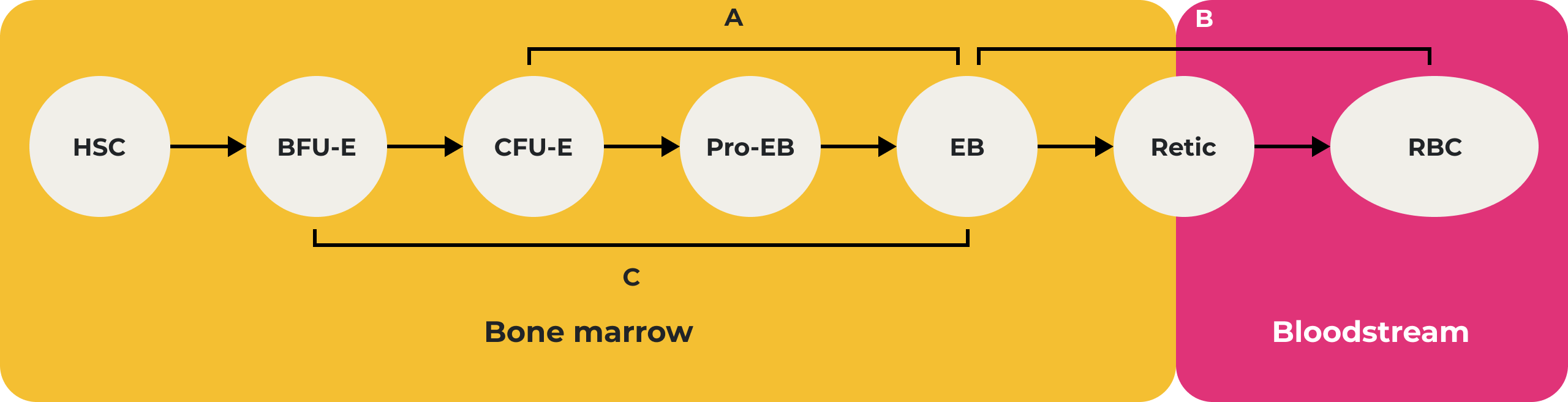
HSC, hematopoietic stem cell; BFU-E, burst-forming unit-erythroid; CFU-E, colony-forming unit-erythroid; Pro-EB, proerythroblasts; EB, erythroblasts; Retic, reticulocytes; RBC, red blood cell.



References

References
- Koury MJ, Ponka P. New insights into erythropoiesis: the roles of folate, vitamin B12, and iron. Annu Rev Nutr. 2004;24:105–131.
- Hamza E, Metzinger L, Metzinger-Le Meuth V. Uremic Toxins Affect Erythropoiesis during the Course of Chronic Kidney Disease: A Review. Cells. 2020;9(9):2039.
- Bunn HF. Erythropoietin. Cold Spring Harb Perspect Med. 2013;3(3):a011619.
- Schoener B, Borger J. Erythropoietin Stimulating Agents. In: StatPearls [Internet]. Treasure Island (FL): StatPearls Publishing; Updated July 2024. Available from: https://www.ncbi.nlm.nih.gov/books/NBK536997/ Accessed June 2026.
- Kidney Disease: Improving Global Outcomes (KDIGO) Anemia Work Group. 2026;109(1S):S1-S99.
- Portolés J, Martin L, Broseta JJ, et al. Anemia in chronic kidney disease: From pathophysiology and current treatments, to future agents. Front Med (Lausanne). 2021;8:642296.
- Badura K, Janc J, Wąsik J, et al. Anemia of Chronic Kidney Disease-A Narrative Review of Its Pathophysiology, Diagnosis, and Management. Biomedicines. 2024;12(6):1191.
- Jörg DJ, et al. Mechanisms of hemoglobin cycling in anemia patients treated with erythropoiesis-stimulating agents. PLoS Comput Biol. 2023;19(1):e1010850.
- Warner MJ, Kamran MT. Iron Deficiency Anemia. In: StatPearls [Internet]. Treasure Island (FL): StatPearls Publishing; Updated August 2023. Available from: https://www.ncbi.nlm.nih.gov/books/NBK448065/ Accessed June 2026.
- Ems T, St Lucia K, Huecker MR. Biochemistry, Iron Absorption. In: StatPearls [Internet]. Treasure Island (FL): StatPearls Publishing; Updated April 2023. Available from: https://www.ncbi.nlm.nih.gov/books/NBK448204/ Accessed June 2026.