

Course disclosure
- This educational program has been developed by CSL Vifor
- It is intended to provide pertinent data to assist healthcare professionals in forming their own conclusions and making decisions
- It is not intended to replace the judgment or experience of the attending provider or other medical professionals
- Case studies are fictional and intended for educational purposes only
- All prescribing decisions are the sole responsibility of the attending provider


Can you help these patients with the treatment of their anemia associated with chronic kidney disease (CKD)?

Heather
New dialysis patient

Michael
Maintenance dialysis patient receiving regular treatment for anemia
Please note: these modules are focused on the assessment and treatment of anemia associated with CKD and are not inclusive of all aspects of care in CKD.
Heather is a devoted homemaker in her late 50s who finds her greatest joy in the warmth of her family. Married for over thirty years, she considers her role as a wife and mother her true North.
Recently, Heather has begun dialysis, and the transition has been physically demanding. She often finds herself struggling with a deep, persistent tiredness that makes keeping up with her usual routine difficult. Despite her exhaustion, she still finds solace in her heirloom roses and antique hunting. Though she now cherishes the quiet, restful moments with her loved ones more than ever.


Sitting in that chair for the first time, hearing the hum of the machine... it finally made everything feel real. I’ve spent my whole life being the rock for my family, and now I’m the one who feels fragile.
Summary of medical history
- 5 ft 4 in (163 cm); 110 lbs (50 kg)
- Born with anomalies of the urinary tract, causing vesicoureteral reflux at a young age
- Hypertension since her early thirties, initially uncontrolled or with intermittent use of therapy. Now receiving, for some time, chronic high-doses of an angiotensin-converting-enzyme (ACE) inhibitor and angiotensin receptor blocker (ARB)
- Recent disease progression to Chronic Kidney Disease Stage G5 receiving Hemodialysis (CKD G5HD)
- Estimated glomerular filtration rate (eGFR): ~10 ml/min per 1.73 m2
- Persistent fatigue
- Loss of appetite leading to reluctance to cook and skipping meals
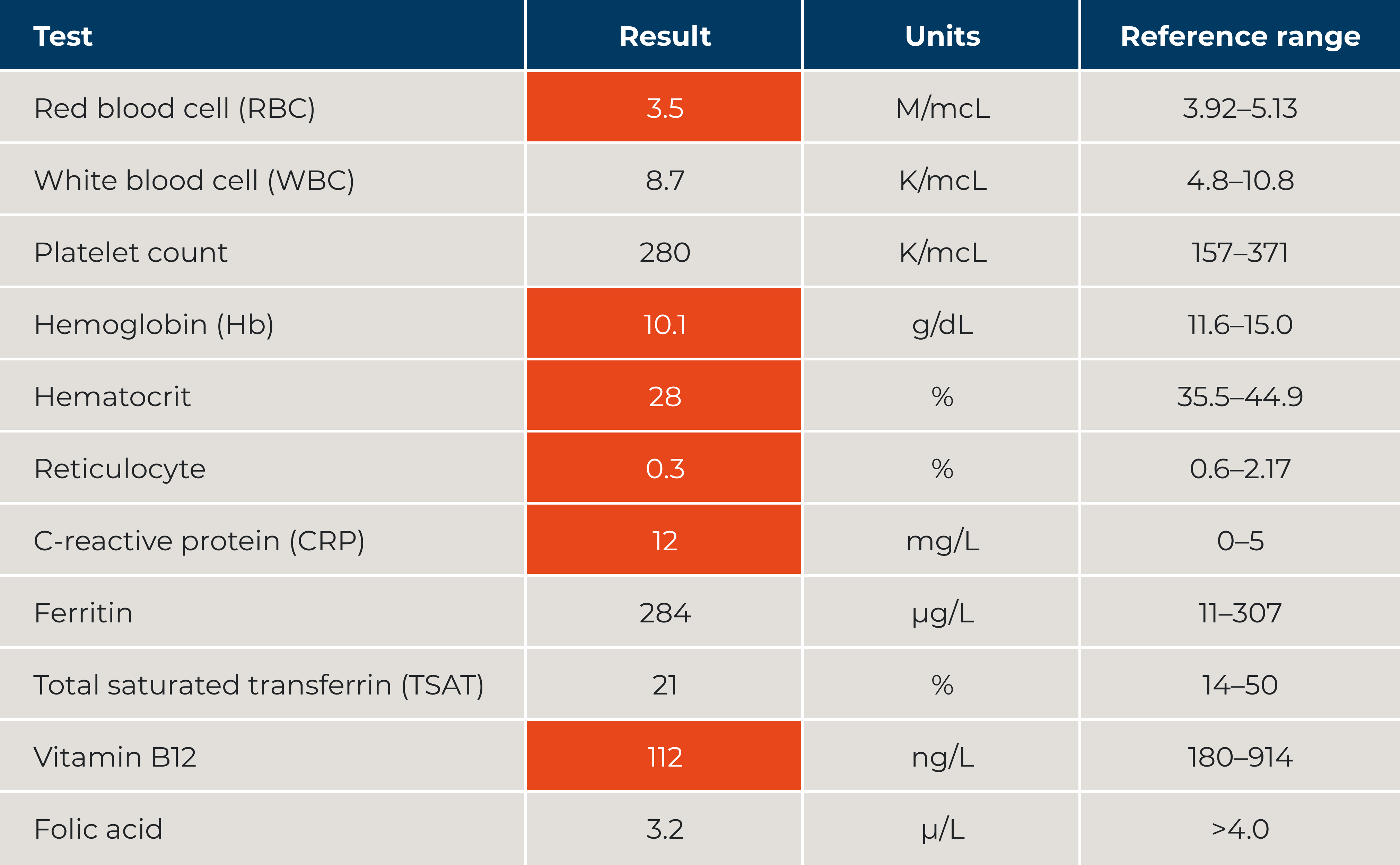
Reference ranges from Mayo Clinic Laboratories.

“It's hard to accept dialysis and my overall condition. I'm still far from ‘normal’, but at least I haven't felt any worse over the last few weeks."
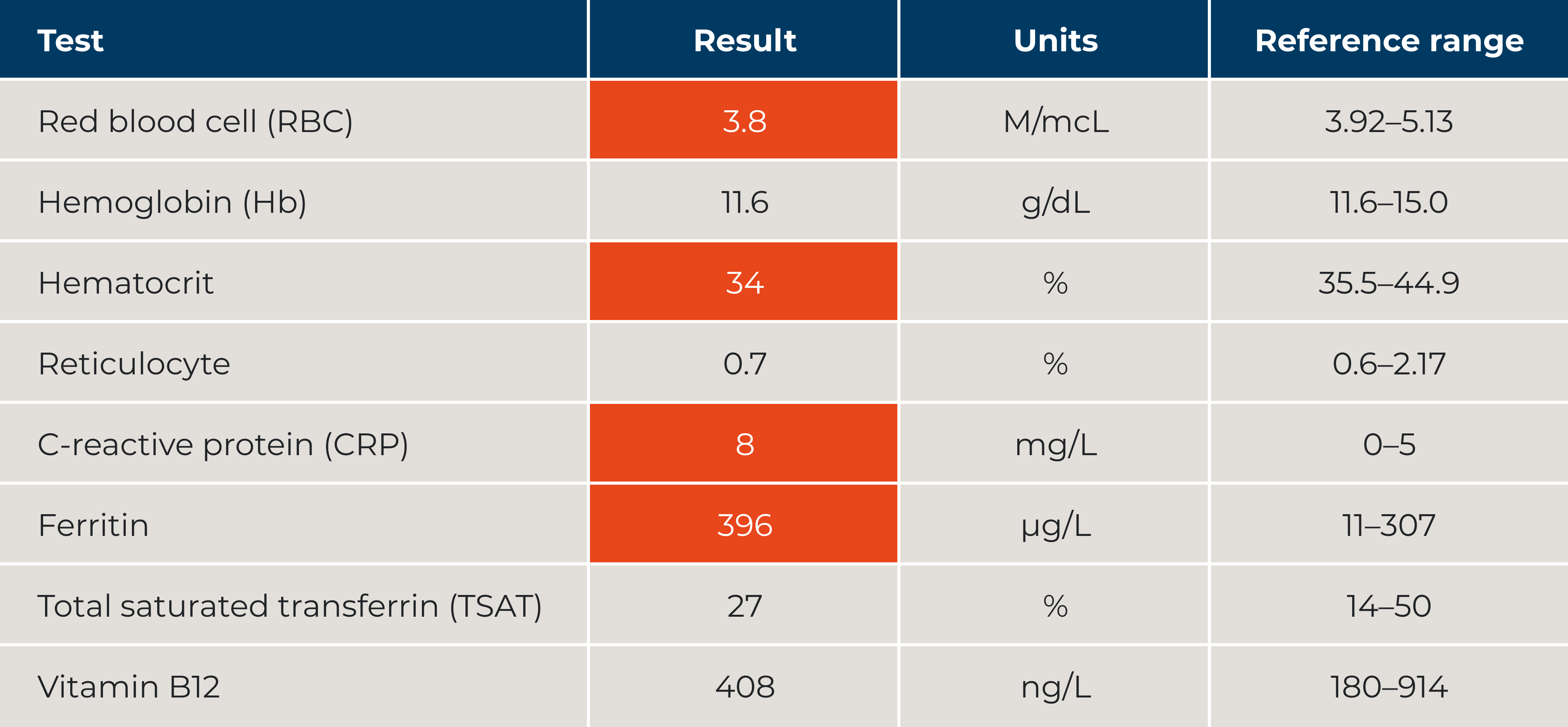
Reference ranges from Mayo Clinic Laboratories.
Well done – Heather’s condition is improving
Continue to monitor Heather's anemia and iron parameters regularly, and consider providing additional treatment with iron routinely unless ferritin >700 ng/mL (>700 mg/L) or TSAT ≥40%.1
For now, Heather doesn't require ESA or HIF-PhI therapy.
Further reading
Michael is a devoted grandfather and a pillar of his community who has navigated the challenges of dialysis for several years. He lives for the moments he can spend in the stands watching his grandson play football, though his attendance has become a difficult balancing act. Between the rigid schedule of his hemodialysis sessions and bouts of crushing fatigue, Michael often struggles to be present for every game.
The past year has been particularly gruelling; Michael required two blood transfusions after his lab results caused concern. While extensive gastrointestinal (GI) checkups and diagnostics luckily ruled out any specific source of blood loss, the ordeal left him shaken. Compounded by recent upper respiratory infections that lingered far longer than they used to, these health setbacks have frequently kept him away from the sidelines, missing the precious milestones he cherishes most.

It’s tough sitting in that clinic chair knowing my grandson is out on that field without me. Between the dialysis schedule and these infections that seem to hang on forever, I’ve felt like I was sidelined from my own life. There were days after those transfusions when I just didn’t have the spark left to even get to the car. All I want is to be there in the stands, cheering him on, but lately, my body has been making that a very difficult promise to keep.
Summary of medical history
- 5 ft 11 in (180cm); 180 lbs (81 kg)
- Type 2 Diabetes Mellitus (T2DM) since his mid forties, not always well-controlled
- CKD G5HD; managed with dialysis for 5 years
- Generally well-controlled hypertension for many years, treated with ARB
- Fatigue
- Recurrent upper respiratory tract infection
- Currently anemia management:
- Periodic iron replacement
- Erythropoietin-stimulating agent (ESA) treatment
- Received 2 red blood cell transfusions in the last year
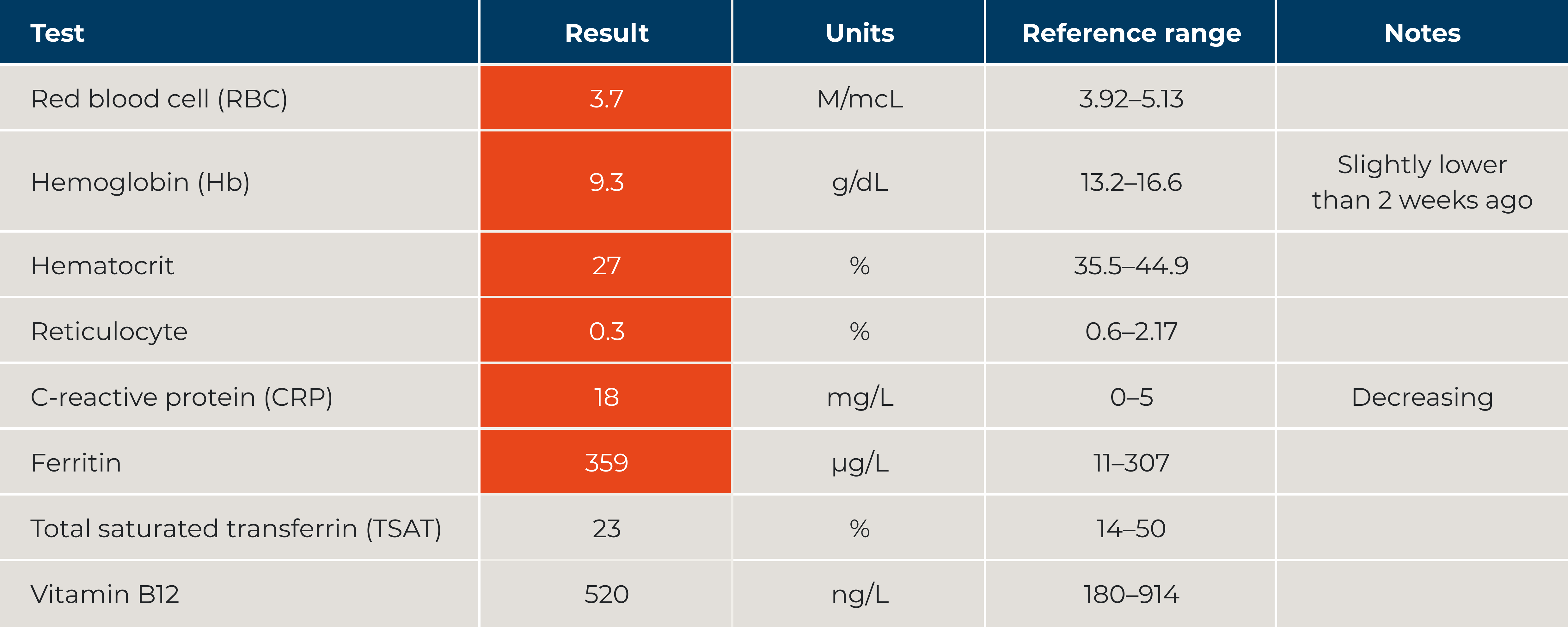
Reference ranges from Mayo Clinic Laboratories.


My doctor told me that we avoided a potential downward spiral and a situation where I would again need hospitalization and RBC transfusion. I'm very happy, as I was worried it would happen again. I'm really tired of being in those places, and I miss being with my loved ones.
Well done
No further treatment is recommended/necessary to manage Michael’s anemia associated with CKD





References

References
- Kidney Disease: Improving Global Outcomes (KDIGO) Anemia Work Group. 2026;109(1S):S1-S99.
- Jörg DJ, et al. Mechanisms of hemoglobin cycling in anemia patients treated with erythropoiesis-stimulating agents. PLoS Comput Biol. 2023;19(1):e1010850.
- Mircera Highlights of Prescribing Information. June 2024.
- Epogen Highlights of Prescribing Information. April 2024.
- Procrit Highlights of Prescribing Information. April 2024.
- Retacrit Highlights of Prescribing Information. June 2024.
- Aranesp Highlights of Prescribing Information. January 2019.